
Congress at the Grassroots
Representational Change in the South, 1970-1998
 Buy the Book:
Amazon
Bookshop.org
Barnes & Noble
University of North Carolina Press
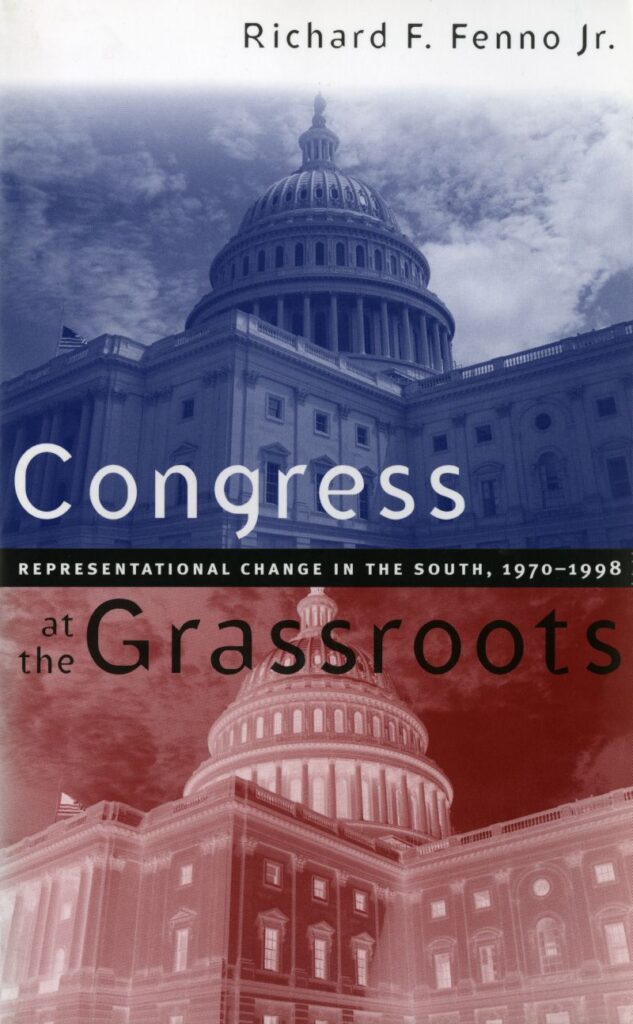
However much politicians are demeaned and denounced in modern American society, our democracy could not work without them. For this reason, says Richard Fenno, their activities warrant our attention. In his pioneering book, Home Style, Fenno demonstrated that a close look at politicians at work in their districts can tell us a great deal about the process of representation. Here, Fenno employs a similarly revealing grassroots approach to explore how patterns of representation have changed in recent decades.
Fenno focuses on two members of the U.S. House of Representatives who represented the same west-central Georgia district at different times: Jack Flynt, who served from the 1950s to the 1970s, and Mac Collins, who has held the seat in the 1990s. His on-the-scene observation of their differing representational styles--Flynt focuses on people, Collins on policy--reveals the ways in which social and demographic changes inspire shifts in representational strategies.
More than a study of representational change in one district, Congress at the Grassroots also helps illuminate the larger subject of political change in the South and in the nation as a whole.
Review of Congress at the Grassroots: Representational Change in the South, 1970-1998 by Richard F. Fenno, Jr.
Robert P. Steed
Journal of Interdisciplinary History, Vol. 32, No. 1. (Summer, 2001), pp. 149-150.
These case studies are fascinating accounts of two politicians and their differing approaches to constituent relations and representation. Fenno tells those stories well. But the deeper value of this book is its deft examination of the recent history of southern political transformation, contextual change, and the related alteration of representational strategies in Congress. Though Fenno is careful to note the methodological limitations of his approach, and is circumspect in his generalizations, his insights are surely on target. This slim volume makes an elegant case for studying political change at the constituency level in order to understand change at the Congressional level.
Congress at the Grassroots: Representational Change in the South, 1970-1998 by Richard F. Fenno, Jr.
Burdett A. Loomis
The American Political Science Review, Vol. 95, No. 2. (Jun., 2001), pp. 472-473.
Just when we suspected that Fenno could not wring one more set of insights from his "soaking and poking" political anthropology, he produces a book that tells a profound tale of political change in the South (and in suburbia), gives us a grounded study of what it means to represent a constituency, and offers an understanding of both the Rayburn and Gingrich eras in the House of Representatives. In addition, students of Congress can enjoy this book in its nuanced referencing of Home Style, Fenno's still-relevant study of House members in their constituencies, published in 1978.
Congress at the Grassroots is a valuable addition to the literature because of the continuing quality of Fenno's observations, especially as they are tied to a clear-headed view of an extremely complex process. The book adds to our understanding of Congress by looking through the prism of constituency relations and the evolution of districts, but its greatest value is to allow a shrewd scholar to take one more look at the subject that has fascinated him for so long. Fenno was there to watch country stores become convenience outlets, power brokers become supernumeraries, and conservatives register as Republicans, not Democrats.
At first glance, this might seem a slight book on a slight subject. The district is merely one of 435, and the MCs, while competent and successful, are obscure. Yet, as always, Fenno has the wit to understand the broader significance of this extended case. In the end, he touches such important and well-researched subjects as role of party, the change in campaign styles, the coming of ideological partisanship (especially from the Right), and the complexities of representation. All in all, that is not bad for a slender volume and a set of old notebooks.