
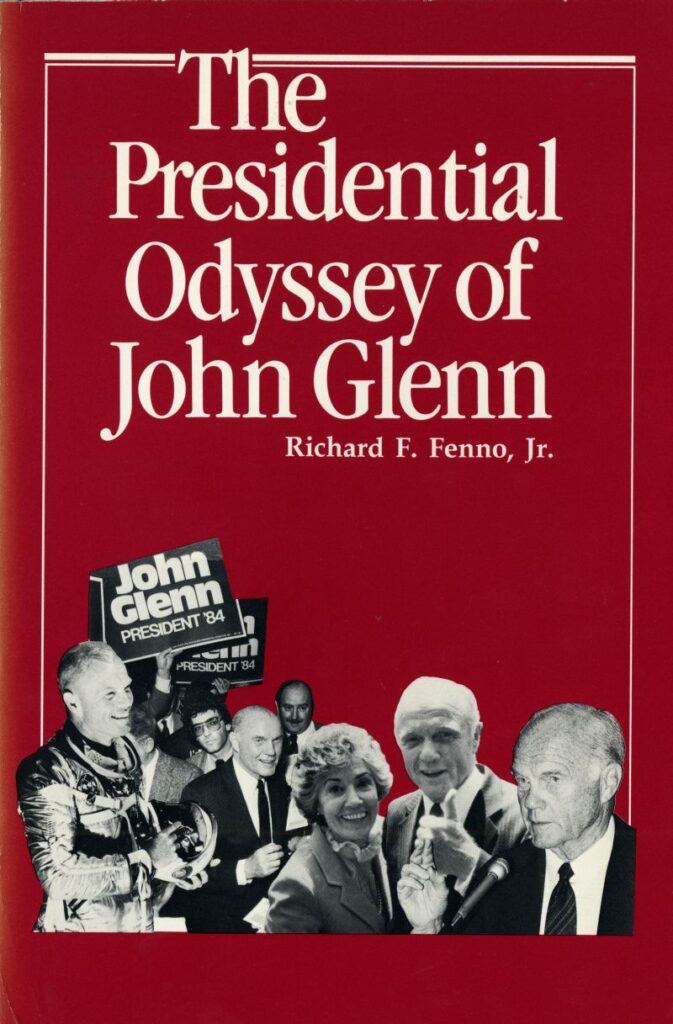
The Presidential Odyssey of John Glenn
 Buy the Book:
Amazon
Political scientists need stories to help them make sense of the world they seek to explain; The Presidential Odyssey of John Glenn should be read as one such story. It is a useful narrative--in depth, over time, and close-up--of a politician at work, pursuing his ambition, interpreting his world, making decisions, and influencing the political life of the country.
Research for this book took place over six years, covering John Glenn's ongoing senatorial career and his presidential campaign. The study begins outside the Senate, moves inside the institution, goes into the country, and returns, finally, to the Senate. That sequence gives the study overall its perspective--as the story of a campaign embedded in a career.
The book examines a number of relatively unexplored questions concerning presidential nomination campaigns. For example, it pays more attention to a losing nomination campaign than political scientists (or journalists) normally do. Assuming that the seeds of losing nomination campaigns are sown well before the first delegate section votes are cast, the books also gives more attention than usual to the long, preliminary campaign-without-voters.
Review: The Senate Quintet
The Making of a Senator: Dan Quayle.
The Presidential Odyssey of John Glenn.
The Emergence of a Senate Leader: Pete Domenici and the Reagan Budget. Learning to Legislate: The Senate Education of Arlen Specter. When Incumbency Fails: The Senate Career of Mark Andrews.
Bryon E. Shafer. The Journal of Politics, Vol. 56, No. 1. (February, 1994).
In magnitude alone, the collection is prodigious, having no obvious counterpart in modern political science. It will come as no surprise that the individual pieces are also models of scholarly presentation. Each is carefully organized to develop its argument. Each is open and self-conscious about the evidence going into that argument, as well — mirabile dictu — as the evidence which is missing. And each is fluently written: These books are "crafted" in the very best sense. Together, they constitute an ambitious example of what direct observation and elite interviewing can produce. Together, they offer an imposing overview of the political life of the penultimate elective elites of American politics, U.S. senators. What these books produce in intellectual terms is equally impressive. At their most immediate and accessible, they provide detailed exposition of some of the central processes of the American politics of our time. Yet while doing so, they employ a carefully specified conceptual framework, running across — and unifying — the entire project. As a result, they exemplify, in much more implicit fashion, a notion of political causality and a view of explanatory mission which are integral to the basic methodological choices of political science. Finally, in a fashion encompassing but going beyond all this, they offer succeeding generations a rich and nuanced picture of contemporary politicking: They are — as political history, too — a landmark.
…
That five contemporary and coordinated volumes, executed in this way and with this reach, are likely to sustain their landmark status long after other contemporary works have passed from the scene. Which is to say: It is a reasonable guess that Dick Fenno has written a central part of the story of the politics of our time. In other words, when political historians need to go back, for a sense of the dynamics of American political life, for the fabric of practical politicking in the late-twentieth century, they are likely to be drawn to the Senate Quintet.