
When Incumbency Fails
The Senate Career of Mark Andrews
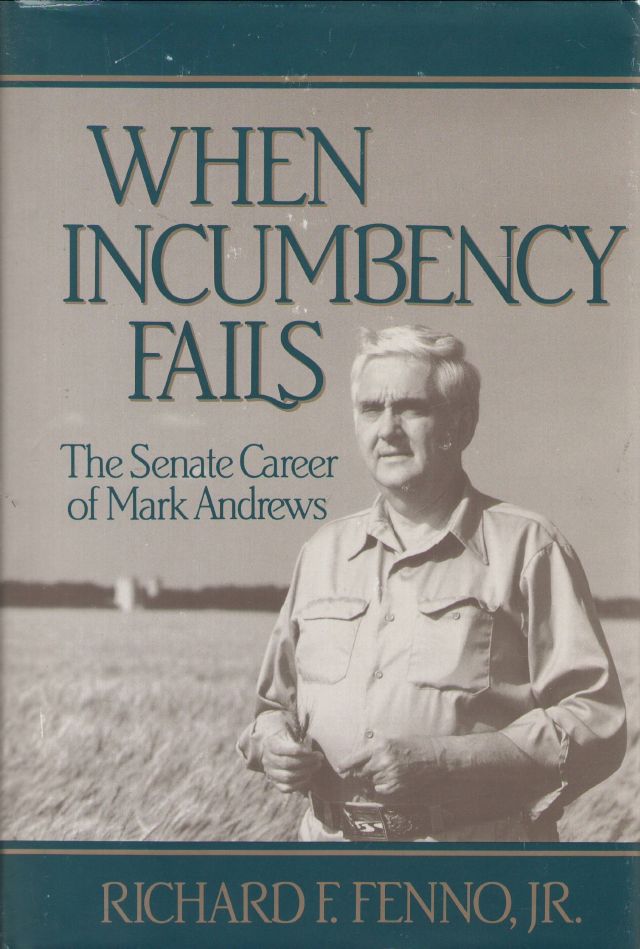
This book is about a puzzling case of outstanding political success followed by unexpected political failure. Political scientists know that incumbent members of the U.S. Congress usually win reelection. This book is about one who did not. After twenty-three years of continuous service--seventeen in the House of Representatives and six in the Senate--Sen. Mark Andrews of North Dakota was defeated for reelection. The central questions of this book are: What happened and why?
Th book's guiding concept is the idea of a political career; its underlying theme is that of political change. Like several other recent books by Fenno, this one is a narrative account. This case study of one U.S. senator rests heavily on personal observations made by the author during visits to North Dakota in 1980, 1982, 1985, and 1986 and during one year, 1981-1982, in Washington.
For its basic outline it relies on the idea of two separable processes of campaigning and governing that are played out in two separate contexts--home and Washington--and on the sequential effects of one process on the other in shaping an individual senator's behavior. Andrews's electoral defeat is viewed as the culminating event in a long political career--a career that was substantially influenced by changing contexts in Washington and North Dakota.
Review: Electoral Vulnerability and the Incumbency Disadvantage
Reviewed Work(s):
When Incumbency Fails: The Senate Career of Mark Andrews by Richard F. Fenno, Jr.
James R. Bowers
Public Administration Review, Vol. 53, No. 5. (Sep. - Oct., 1993), pp. 479-480.
I highly recommend When Incumbency Fails to any reader interested in congressional politics. Students and practitioners of public administration should seriously consider reading at least the relevant chapters mentioned here. In this book, Fenno demonstrates once again why political scientists and public administrators alike need good case studies or stories about the people, processes, and institutions that make up the American political system. Through the story that unfolds in When Incumbency Fails, Fenno shows one more time the usefulness of his "soaking and poking" methodology. Over the years, it has uncovered a great deal about the art and practice of congressional politics. When Incumbency Fails is one more example of its usefulness.
Review: The Senate Quintet
The Making of a Senator: Dan Quayle.
The Presidential Odyssey of John Glenn.
The Emergence of a Senate Leader: Pete Domenici and the Reagan Budget. Learning to Legislate: The Senate Education of Arlen Specter. When Incumbency Fails: The Senate Career of Mark Andrews.
Bryon E. Shafer. The Journal of Politics, Vol. 56, No. 1. (February, 1994).
In magnitude alone, the collection is prodigious, having no obvious counterpart in modern political science. It will come as no surprise that the individual pieces are also models of scholarly presentation. Each is carefully organized to develop its argument. Each is open and self-conscious about the evidence going into that argument, as well — mirabile dictu — as the evidence which is missing. And each is fluently written: These books are "crafted" in the very best sense. Together, they constitute an ambitious example of what direct observation and elite interviewing can produce. Together, they offer an imposing overview of the political life of the penultimate elective elites of American politics, U.S. senators. What these books produce in intellectual terms is equally impressive. At their most immediate and accessible, they provide detailed exposition of some of the central processes of the American politics of our time. Yet while doing so, they employ a carefully specified conceptual framework, running across — and unifying — the entire project. As a result, they exemplify, in much more implicit fashion, a notion of political causality and a view of explanatory mission which are integral to the basic methodological choices of political science. Finally, in a fashion encompassing but going beyond all this, they offer succeeding generations a rich and nuanced picture of contemporary politicking: They are — as political history, too — a landmark.
…
That five contemporary and coordinated volumes, executed in this way and with this reach, are likely to sustain their landmark status long after other contemporary works have passed from the scene. Which is to say: It is a reasonable guess that Dick Fenno has written a central part of the story of the politics of our time. In other words, when political historians need to go back, for a sense of the dynamics of American political life, for the fabric of practical politicking in the late-twentieth century, they are likely to be drawn to the Senate Quintet.