Reviews of Books
Review of Congress at the Grassroots: Representational Change in the South, 1970-1998 by Richard F. Fenno, Jr.
Robert P. Steed
Journal of Interdisciplinary History, Vol. 32, No. 1. (Summer, 2001), pp. 149-150.
These case studies are fascinating accounts of two politicians and their differing approaches to constituent relations and representation. Fenno tells those stories well. But the deeper value of this book is its deft examination of the recent history of southern political transformation, contextual change, and the related alteration of representational strategies in Congress. Though Fenno is careful to note the methodological limitations of his approach, and is circumspect in his generalizations, his insights are surely on target. This slim volume makes an elegant case for studying political change at the constituency level in order to understand change at the Congressional level.
Senators on the Campaign Trail: The Politics of Representation. by Richard F. Fenno, Jr.
Thomas A. Kazee
The American Political Science Review, Vol. 91, No. 3. (Sep., 1997), pp. 738-739.
The methodology is vintage Fenno: “Soak and poke” has become “drop in/drop out, tag along/ hang around” (p. 4). His participant-observer approach has its limitations, to be sure, but part of the magic of a Fenno book is converting the skeptic. Though the uninitiated reader may wonder about replicability and generalizability in this collection of seemingly idiosyncratic stories, somewhere along the way the pieces begin to fit together, and a clearer picture of politics emerges. The key to all this is Fenno’s ability to distill meaning, to see patterns and connections, and to weave them together into a coherent whole. It is perhaps as much art as science, but it works, and our understanding of Congress and the democratic process is much enriched by his efforts.
The book is full of sophisticated insights and plain good sense, from Fenno’s observation that negative campaigning erodes the representational connection to his musings about the role media play in linking legislators and constituents. In sum, in this book students of politics can learn much about Senate elections and, more important, representative democracy.
Congress at the Grassroots: Representational Change in the South, 1970-1998 by Richard F. Fenno, Jr.
Burdett A. Loomis
The American Political Science Review, Vol. 95, No. 2. (Jun., 2001), pp. 472-473.
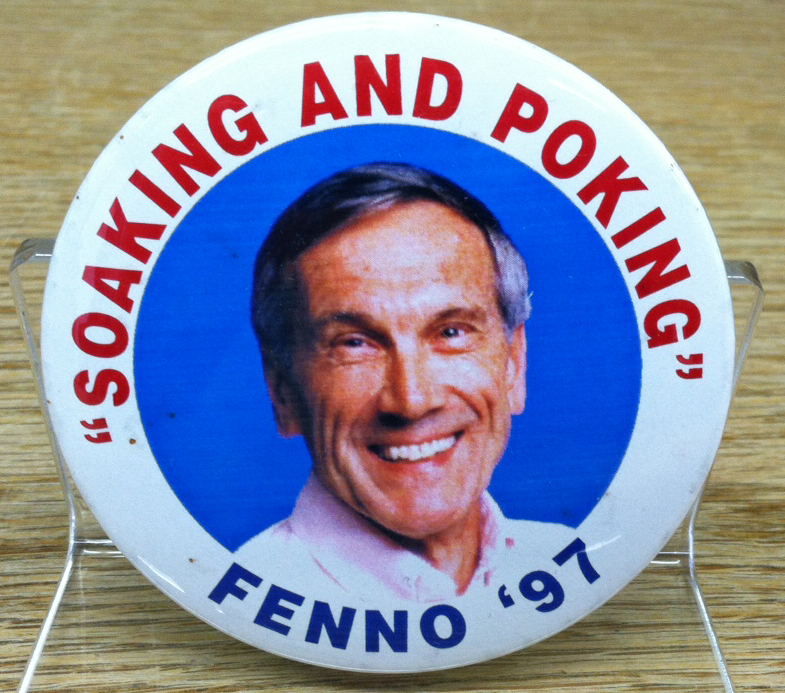
Just when we suspected that Fenno could not wring one more set of insights from his “soaking and poking” political anthropology, he produces a book that tells a profound tale of political change in the South (and in suburbia), gives us a grounded study of what it means to represent a constituency, and offers an understanding of both the Rayburn and Gingrich eras in the House of Representatives. In addition, students of Congress can enjoy this book in its nuanced referencing of Home Style, Fenno’s still-relevant study of House members in their constituencies, published in 1978.
Congress at the Grassroots is a valuable addition to the literature because of the continuing quality of Fenno’s observations, especially as they are tied to a clear-headed view of an extremely complex process. The book adds to our understanding of Congress by looking through the prism of constituency relations and the evolution of districts, but its greatest value is to allow a shrewd scholar to take one more look at the subject that has fascinated him for so long. Fenno was there to watch country stores become convenience outlets, power brokers become supernumeraries, and conservatives register as Republicans, not Democrats.
At first glance, this might seem a slight book on a slight subject. The district is merely one of 435, and the MCs, while competent and successful, are obscure. Yet, as always, Fenno has the wit to understand the broader significance of this extended case. In the end, he touches such important and well-researched subjects as role of party, the change in campaign styles, the coming of ideological partisanship (especially from the Right), and the complexities of representation. All in all, that is not bad for a slender volume and a set of old notebooks.
Review: Electoral Vulnerability and the Incumbency Disadvantage
Reviewed Work(s):
When Incumbency Fails: The Senate Career of Mark Andrews by Richard F. Fenno, Jr.
James R. Bowers
Public Administration Review, Vol. 53, No. 5. (Sep. – Oct., 1993), pp. 479-480.
I highly recommend When Incumbency Fails to any reader interested in congressional politics. Students and practitioners of public administration should seriously consider reading at least the relevant chapters mentioned here. In this book, Fenno demonstrates once again why political scientists and public administrators alike need good case studies or stories about the people, processes, and institutions that make up the American political system. Through the story that unfolds in When Incumbency Fails, Fenno shows one more time the usefulness of his “soaking and poking” methodology. Over the years, it has uncovered a great deal about the art and practice of congressional politics. When Incumbency Fails is one more example of its usefulness.
The Power of the Purse: Appropriations Politics in Congress by Richard F. Fenno, Jr.
George Frederickson
Administrative Science Quarterly, Vol. 14, No. 1. (Mar., 1969), pp. 138-139.
Readers interested in either legislative behavior or the politics of money will find this book an invaluable contribution. If Fenno were not already ensconsed among the leading authorities in these two fields. The Power of the Purse would surely do it.
Review: The Senate Quintet
The Making of a Senator: Dan Quayle.
The Presidential Odyssey of John Glenn.
The Emergence of a Senate Leader: Pete Domenici and the Reagan Budget. Learning to Legislate: The Senate Education of Arlen Specter. When Incumbency Fails: The Senate Career of Mark Andrews.
In magnitude alone, the collection is prodigious, having no obvious counterpart in modern political science. It will come as no surprise that the individual pieces are also models of scholarly presentation. Each is carefully organized to develop its argument. Each is open and self-conscious about the evidence going into that argument, as well-mirabile dictu-as the evidence which is missing. And each is fluently written: These books are “crafted” in the very best sense. Together, they constitute an ambitious example of what direct observation and elite interviewing can produce. Together, they offer an imposing overview of the political life of the penultimate elective elites of American politics, U.S. senators. What these books produce in intellectual terms is equally impressive. At their most immediate and accessible, they provide detailed exposition of some of the central processes of the American politics of our time. Yet while doing so, they employ a carefully specified conceptual framework, running across-and unifying-the entire project. As a result, they exemplify, in much more implicit fashion, a notion of political causality and a view of explanatory mission which are integral to the basic methodological choices of political science. Finally, in a fashion encompassing but going beyond all this, they offer succeeding generations a rich and nuanced picture of contemporary politicking: They are–as political history, too–a landmark.
…
That five contemporary and coordinated volumes, executed in this way and with this reach, are likely to sustain their landmark status long after other contemporary works have passed from the scene. Which is to say: It is a reasonable guess that Dick Fenno has written a central part of the story of the politics of our time. In other words, when political historians need to go back, for a sense of the dynamics of American political life, for the fabric of practical politicking in the late-twentieth century, they are likely to be drawn to the Senate Quintet.
Bryon E. Shafer. The Journal of Politics, Vol. 56, No. 1. (February, 1994).
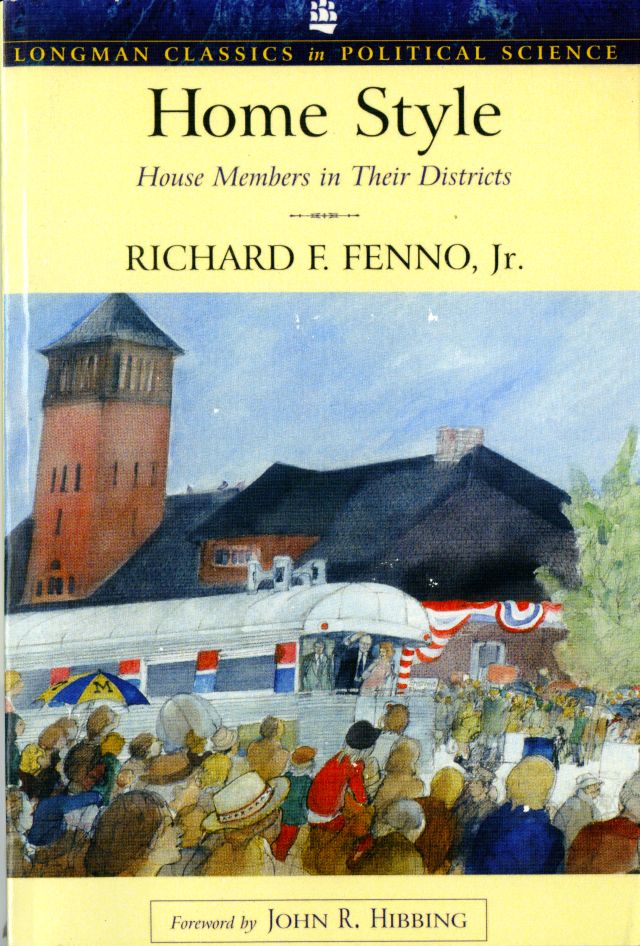
Review of Home Style: House Members in their Districts by Roger H. Davidson. The American Political Science Review, Vol. 73, No. 2. (June, 1979).
In this superb guidebook to the “world of shopping bags,” Fenno once again confirms his reputation as one of the best, perhaps the best, scholar of American politics. Quite properly, his book is reminiscent of those ancient explorers’ maps, detailed in places but containing large blank spaces marked as “unknown territory.” The test of Fenno’s perspicacity will be how rapidly, and how fruitfully, his colleagues rush to fill in those voids.
Watching Politicians: Essays on Participant Observation. by Richard E. Fenno, Jr.
Alan Rosenthal
The Journal of Politics, Vol. 53, No. 2. (May, 1991), pp. 563-565.
The five essays in this book focus on “participant observation,” “direct observation,” or “soaking and poking.” Whichever designation we use, it is the mode of research conducted so effectively by Richard Fenno for the past 20 years. As might be expected, these essays are not only informative, they are delightful as well. They should be required reading for everyone who practices political science as a profession or is thinking about doing so.
The Contributions of President Richard F. Fenno, Jr.
Nelson W. Polsby
PS, Vol. 17, No. 4. (Autumn, 1984), pp. 778-781.
Fenno has given an account of his methods of investigation in a methodological appendix to his prize-winning book Home Style which can be read for its entertainment value alone, but which in addition sheds much light on the ethical and tactical dilemmas of field work in the social sciences. It is also a fascinating autobiographical document, disclosing to the reader a thoroughly admirable and interesting man.